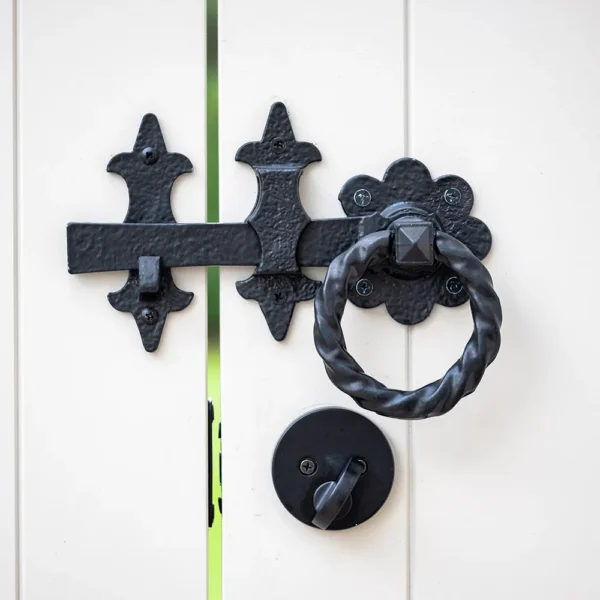

Whether you’re a fencing contractor installing gates for residential or commercial properties, or a homeowner looking to protect your family and belongings, a reliable gate lock is essential.
There are many different types of gate lock available, and at Abbey, we provide them all. But this decision isn’t just about security—it’s about finding the right balance of protection, convenience, and adaptability to meet your unique needs.
From high-security deadbolts to simple, lockable latches designed for ease of use, in this blog we’ll explore the most common types of gate lock – plus key considerations around installation, performance and maintenance – with lots of advice to help you make a choice that’s both practical and dependable.

Why do I need a gate lock?
Regardless of whether your gate is on a residential property or a commercial premises, there are two main reasons to lock it – security, and safety. Here are some common reasons you might want to make outdoor spaces lockable:
- To keep kids and pets safely inside your back yard
- To deter burglars and cold callers
- To prevent theft of vehicles, equipment or inventory
- To prevent accidents around pools or machinery
- To ensure only authorised personnel can access private or restricted areas
- To meet legal or insurance requirements around safety & security
What are the most common types of gate lock?
There are many different types of gate lock, especially when you consider that the majority of gate latches are also designed to be lockable with the use of a padlock. You can learn more about lockable gate latches here, but for the purposes of this blog, we’re going to focus on gate locks that are integrated – that is, the locking mechanism is integrated into the design, so you don’t need to use a separate padlock and key. Here are the four most common types we stock at Abbey Hardware:

1. Deadbolts
A deadbolt is a secure locking mechanism that uses a solid, heavy-duty bolt to secure a door or gate, making it highly resistant to forced entry or tampering.
Unlike spring-based locks, which can be retracted by pushing on a lever, a deadbolt requires a key, thumbturn or digital keypad to retract the latch, and close it again. The Gatemaster BLD series from Abbey is an exception to this – it’s an auto latching deadbolt, offering enhanced security and hands-free operation.
The bolt on a deadbolt extends directly into the doorframe or gatepost, providing a firm hold and enhanced security, and we offer adjustable options to ensure a secure fit on any gate configuration. Deadbolts come in various types – keyed on one side only with a lever on both sides, or keyed on both sides.
Deadbolts are typically made from durable materials like hardened steel or brass to resist corrosion and tampering, and are commonly used for residential front doors, perimeter gates, and commercial entrances.

2. Rim locks
A rim lock functions in much the same way as a mortice lock, but instead of the lock being installed into a pocket in the gate or door, the lock is generally surface mounted. The extra long throw on our rim locks makes them ideal for wood gates, since they can account for expansion and contraction. Rim locks have been around for generations and are still a popular choice, offering simple, reliable performance and easy installation.
Lockable latches
Auto-latches (also called self-closing latches) are one of the most common types of gate latch, popular because they’re inexpensive, easy to install and excellent for keeping gates securely closed without the need to manually shoot a bolt across.
Self-closing latches have a latch body with a latch pin or arm that protrudes from the edge of the gate. When the gate swings shut, the latch arm enters a catch plate that swings shut, preventing the gate from being opened unless a lever on the catch plate is pressed. An upgrade on this is a lockable auto-latch, which works in the same way, but has an integrated key lock that means the latch cannot be opened without a key. These latches can be one-sided or two-sided;our most popular option is two-sided models and requires a key to open from both sides, but a one-sided option is also available – this requires a key to open from one side, but can be opened with a thumb latch on the other.

Magnetic locks
Magnetic locks such as the Magnalatch ® Series 3 product are specifically developed for situations where safety is the primary concern – usually for pool enclosures, where it’s essential that people can’t enter the poolside area unsupervised.
These latches use a permanent magnet to create a strong, self-latching action. When the gate swings shut, the magnetic force automatically draws the latch into the locked position, reducing the risk of the gate being accidentally left open.
The permanent magnet plays a critical role in safety by providing consistent, reliable latching every time the gate closes. Unlike mechanical latches, which can stick or fail to engage if not properly aligned, a magnetic latch works seamlessly regardless of minor misalignments caused by wear, weather, or gate movement. This ensures that the gate remains latched even if it is not pushed shut with full force, an essential feature for pool enclosures where safety is paramount.
Magnetic latches are also often designed to meet or exceed local pool safety codes. They often have a ‘top pull’ opening mechanism that must be pulled upwards to a height out of reach of small children, and feature durable, weather-resistant materials to maintain performance over time.

Should I install a keyed or digital gate lock?
The decision on whether to install a conventional keyed or digital lock with a keypad depends on a number of factors including cost, security and practicality.
Keyed locks
Keyed locks are the most common type and also the most affordable, with a wide range of styles and price points available to suit any project. They’re a classic, straightforward option, providing reliable security and allowing multiple keyholders to gain access to private or restricted areas. However, managing physical keys can sometimes be inconvenient, especially if multiple people require access or if keys get lost. It’s also possible for unauthorized individuals to gain entry if they can get access to the key.
Keyless or digital gate locks offer a more modern and secure approach because they require the user to enter a key code in order to open the lock – there are no keys that can be lost or stolen. However, the initial outlay is higher than for a simple keyed lock.

Digital locks
Digital keypad locks are ideal for busy households or businesses where multiple users need entry, eliminating the need to manage multiple keyholders. Codes or credentials can be easily shared, updated, or revoked – so even if you forget the code, the lock can simply be reprogrammed. Digital locks often come with advanced features like temporary access codes or audit trails, making them particularly useful for rental properties or shared spaces. Our range of digital locks has the added convenience of not needing batteries.
How easy is it to install a gate lock?
Most gate locks are straightforward for a professional to install, but there is added complexity for mortice locks and deadbolts because it’s vital that the latch or bolt aligns perfectly with the striker plate or bolt hole, or the lock won’t close.
Locking latches are the simplest to install and can be done by a competent DIYer – look for products that have vertical and horizontal adjustment so you can easily achieve a snug fit.
What else should I consider when selecting a gate lock?
One of the most important factors to consider is the materials your gate lock is made from. Cheaper gate locks are often made from inferior materials that can warp, bend or corrode over time. Look for locks with mechanisms made from robust metals like stainless steel or brass, that won’t rust even in coastal environments or wet climates, ensuring the lock will move smoothly for many years. For the body of the lock, consider powder coated or vinyl options to give added weather resistance.
You should also pay attention to the fasteners used to install your gate lock – there’s no point having a highly secure lock if it’s attached using simple screws that can easily be removed. Many of Abbey Hardware’s gate locks are supplied with tamper-proof security fixings.
Finally, make sure the lock you choose is compatible with your gate or fence – for example, if you’re installing a lock on a chain link fence with round posts, you may need to purchase a post adapter to make your preferred lock fit.
How should I look after my gate lock?
Most gate locks require little maintenance once installed, especially if you choose a high-quality product made from corrosion-resistant materials. It’s always wise to keep lock barrels lubricated to prevent seizing, especially during cold weather. Ensure the lock plate is kept clean and free from dirt or debris to prolong its life – and always use the best quality materials you can for fence and gate construction, as this prevents warping and sagging that can prevent locks from latching securely.
Need more information?
If you need help selecting the right gate lock for a specific fencing project, our knowledgeable team will be happy to help – simply get in touch.